Tax, legal & title
Rental income tax: residents vs non-residents
Quick answerRent from a Malaysian property is Malaysian-sourced income. Tax residents (generally 182+ days a year in Malaysia) pay progressive personal rates; non-residents (most Singaporean and foreign owners) are generally taxed at 30% of net rent with no personal reliefs. Net rent = rent − allowable expenses (assessment, quit rent, loan interest, maintenance, fire insurance, repairs). Singapore generally doesn't tax foreign-sourced income received by individual residents (check with IRAS).
30-second summary
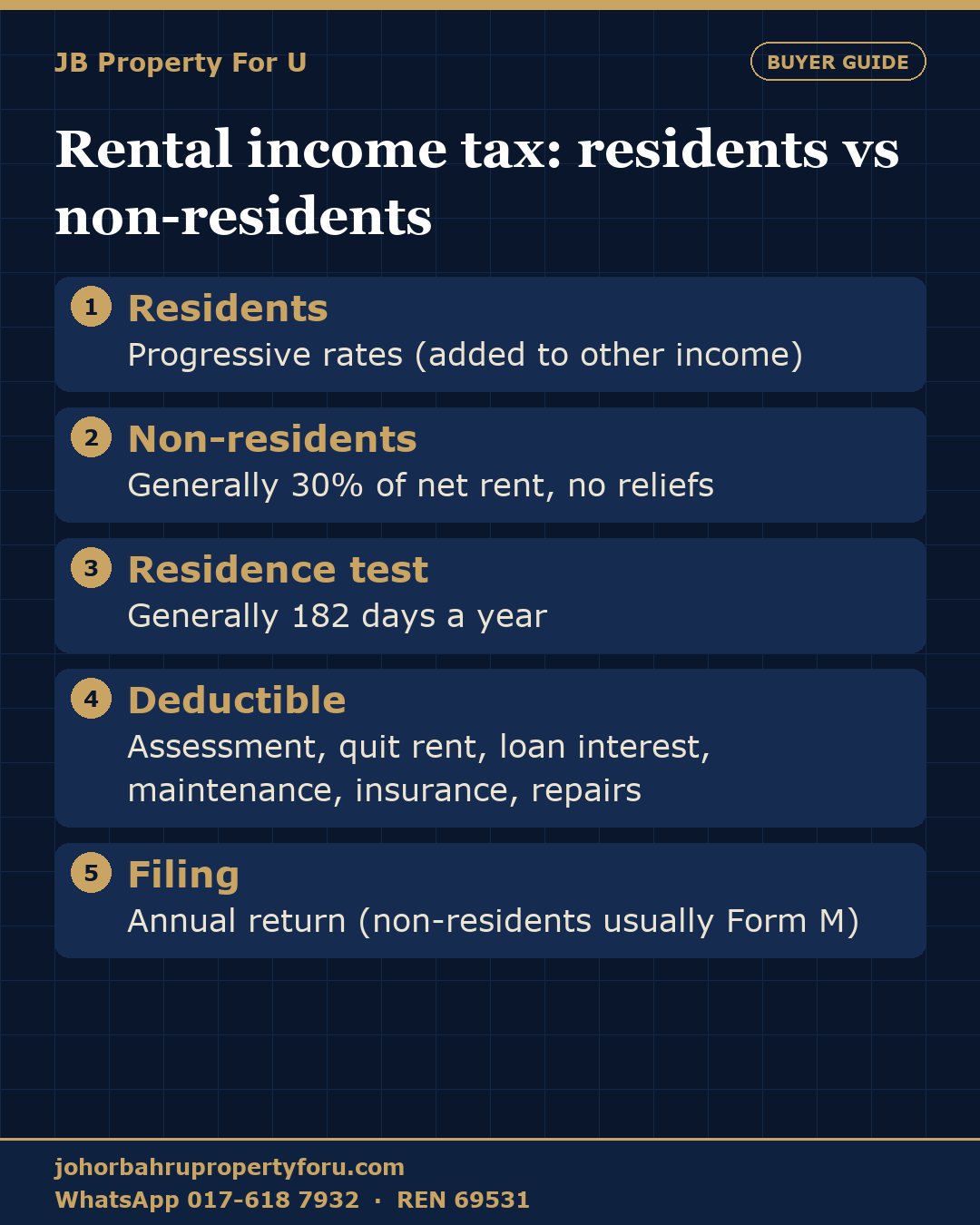
- Residents: Progressive rates (added to other income)
- Non-residents: Generally 30% of net rent, no reliefs
- Residence test: Generally 182 days a year
- Deductible: Assessment, quit rent, loan interest, maintenance, insurance, repairs
- Filing: Annual return (non-residents usually Form M)
- Singapore: Foreign income of individuals generally exempt (per IRAS)
Who is a non-resident?
Malaysian tax residence generally depends on 182 days or more in Malaysia in a year (with other rules for consecutive years). An owner living in Singapore and visiting JB at weekends is usually a non-resident.
Allowable expenses (general)
- Assessment tax (cukai pintu)
- Quit rent (cukai tanah)
- Home loan interest (not principal)
- Maintenance fee and sinking fund (condos)
- Fire / home insurance
- Repairs and maintenance (not improvements)
- Agent fees on renewal, etc. (case by case)
Example (non-resident)
| Per year | |
|---|---|
| Rent RM3,500 × 12 | RM42,000 |
| Less: loan interest | RM20,000 |
| Less: maintenance + sinking fund | RM4,800 |
| Less: assessment + quit rent + insurance | RM1,600 |
| Less: repairs | RM1,000 |
| Net rent | RM14,600 |
| Non-resident 30% | about RM4,380 |
Short-term rentals (Airbnb)
- Many condos' management bodies (JMB / MC) ban or restrict short stays — ask before buying.
- Short-term income is taxable too; frequent operation may be treated as business income.
The Singapore side
Per IRAS, foreign-sourced income received in Singapore by individual tax residents is generally exempt (except through Singapore partnerships). Malaysia and Singapore have a double tax agreement. Everyone's situation differs — consult a tax adviser.
Infographic — save & share
Tap the image to open it full size, then save it or share it to WhatsApp, Facebook or Instagram.
Frequently asked questions
Do Singaporeans pay Malaysian tax on rent from a JB home?
Yes. It is Malaysian-sourced income; non-residents are generally taxed at 30% of net rent and must file yearly.
What expenses can be deducted from rental income?
Generally assessment, quit rent, loan interest, maintenance and sinking fund, fire insurance and repairs; not loan principal or improvements.
Will Singapore tax my JB rent too?
Per IRAS, foreign-sourced income received in Singapore by individual tax residents is generally exempt (except through partnerships). Confirm with IRAS or a tax adviser.
Can I run an Airbnb in my condo?
It depends on the building's management rules — many condos ban or restrict short-term rentals. Ask before you buy.